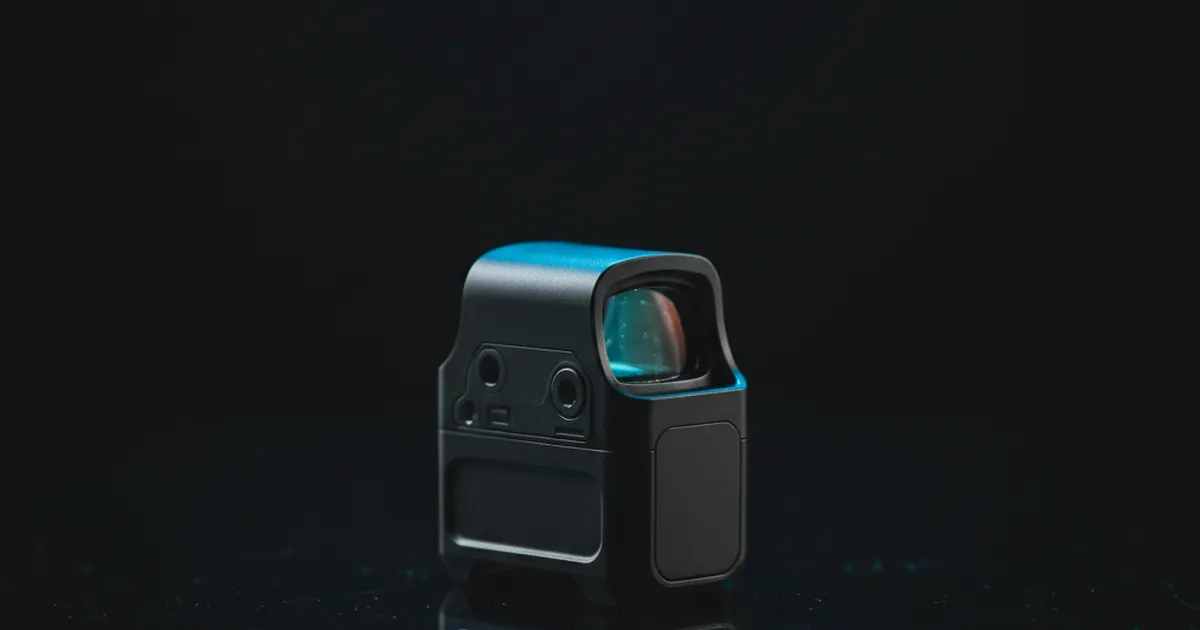

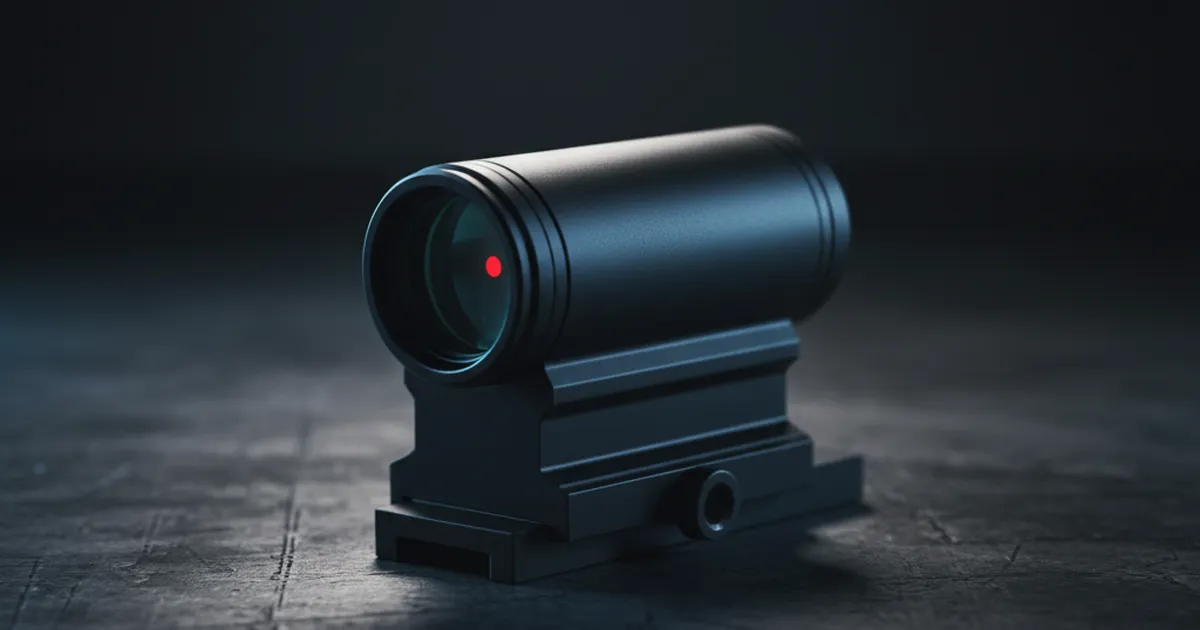


A budget red dot is the fastest, cheapest upgrade you can make to a rifle or carbine — but "cheap" and "reliable" only overlap when the optic has the right features. A budget red dot sight is a 1x (non-magnifying) reflex optic, usually in a tube housing, that projects an illuminated aiming dot onto its lens for fast both-eyes-open target acquisition, at an entry-level price. The price you pay matters far less than three things: whether it stays powered, whether it holds zero, and whether it survives recoil.
Key Takeaways
- Motion-wake is the feature that matters most. MOTAC (Sig) and Shake Awake (Holosun) keep the dot ready without draining the battery — the difference between a defensive optic and a range toy.
- Battery life ranges wildly at this price: from ~5,000 hours (TRS-25) to 50,000 (Holosun HS403B). Longer is better, and it pairs with motion-wake to mean "always on."
- Solar is normally a premium feature. A solar-failsafe red dot from the category leader runs about $210, so a $129.99 solar option is a real bargain — if the panel genuinely backs up the battery.
- Dot size: 2 MOA is more precise; 3 MOA is faster to find but coarser. Most budget dots are 2–3 MOA.
- Holding zero comes down to a 7075-T6 (or equivalent) aluminum housing and a solid mount — verify return-to-zero after mounting, and run co-witness irons as a backup.
How to Choose a Budget Red Dot
Under $200, you can't have everything — so spend on the features that keep the optic working:
- Power management first. Motion activation (MOTAC / Shake Awake / AutoLive) plus a long battery means the dot is on when you need it and off when you don't. Treat a short battery with no auto-off as a real limitation on a defensive gun.
- Durability. Look for a 7075-T6 aluminum housing and a real ingress rating (IP67 / IPX-7). These hold zero through recoil and shrug off rain; a sealed tube is worth more than a spec-sheet brightness number.
- Footprint and mount. The Aimpoint-Micro (T1) footprint is the most common, so mounts, risers, and magnifiers are cheap and everywhere. A good absolute or lower-1/3 co-witness mount is half the battle.
- Reticle. 2 MOA for precision, 3 MOA for speed. Either works at carbine distances; pick for your use.
| Optic | Dot | Battery | Motion-Wake | Price |
|---|---|---|---|---|
| Sig Romeo5 Gen II | 2 MOA | ~40,000 hr | MOTAC | ~$119.99 |
| Holosun HS403B | 2 MOA | 50,000 hr | Shake Awake | ~$205 |
| Accufire QSO-S Solar | 3 MOA | 20,000 hr + solar | None | $129.99 |
| Accufire QSO | 3 MOA | 20,000 hr | None | $119.99 |
| Bushnell TRS-25 | 3 MOA | ~5,000 hr | None | ~$119.95 |
| Primary Arms Classic 25mm | 3 MOA | 25,000 hr | None | ~$86.90 |
1. Sig Sauer Romeo5 Gen II — Best Overall Value
The Sig Sauer Romeo5 Gen II (~$119.99–$124.99) is the one most shooters should buy first, and the optic every other budget dot gets measured against. Its MOTAC motion system wakes the 2 MOA dot the instant the rifle moves and sleeps it when you set the gun down, so it's effectively always ready while a ~40,000-hour CR2032 battery barely drains. Add an IPX-7 rating and the near-universal Aimpoint-Micro footprint — meaning mounts and magnifiers are cheap and everywhere — and it's the best all-around value here. Sig's spotty customer service is the only real knock, and there's no solar.
2. Holosun HS403B — Longest Battery, Most Proven
The Holosun HS403B (~$205 street) is the durability-and-runtime pick. Its 2 MOA dot is backed by Shake Awake and a class-leading 50,000-hour battery, with an IP67-rated aluminum housing that has earned a reputation for taking abuse. The catch is the price: street cost has crept toward $200, which narrows its advantage over the Romeo5. If you want the most proven feature set and don't mind paying a little more for the longest battery life in the group, it's the safe choice.
3. Accufire QSO-S Solar — Best Solar Value
The Accufire QSO-S Solar ($129.99) is the value standout for one concrete reason: solar is normally a premium feature. The cheapest solar-failsafe red dot from the category leader runs about $210, so getting a solar panel plus a 20,000-hour CR1632 battery at $129.99 undercuts established solar optics by roughly $80. The hardware is honest budget-grade — a 3 MOA dot, 10 brightness settings, a 28×17.5 mm window, ±50 MOA of 1-MOA-click adjustment, an IPX-7 rating, and a 7075-T6 aluminum housing. It lacks true motion-wake and the 3 MOA dot is coarser than a 2 MOA, but if solar backup appeals, nothing else here gets you there for this little.
4. Accufire QSO — Best No-Frills Value
If you don't need solar, the Accufire QSO ($119.99) is the no-frills sibling: the same 7075-T6 aluminum housing and IPX-7 sealing as the QSO-S, a 3 MOA dot, 10 brightness settings, and a more common side-loading CR2032 battery rated to 20,000 hours, with 1800G vibration resistance — for ten dollars less. There's no motion-wake and the dot is coarser than the 2 MOA leaders, but as a durable plinking-and-training optic at $119.99 it holds its own against the Bushnell and undercuts most name-brand 2 MOA dots.
5. Bushnell Trophy TRS-25 — Most Compact
The Bushnell Trophy TRS-25 (~$119.95, often under $100 on the street) is the smallest and simplest pick, and a proven seller for years. Its compact body rides well on a .22, a shotgun, or a low-recoil carbine, and the O-ring-sealed IPX5 housing carries a lifetime warranty. The limits are real: the 3 MOA dot is powered by a battery rated to only about 5,000 hours, and there's no motion-wake or auto-off, so you have to remember to switch it off. It's the least set-and-forget option, but for a light, cheap, dependable dot it endures for a reason.
6. Primary Arms Classic 25mm — Cheapest Entry
The Primary Arms Classic 25mm Push-Button (~$86.90) is the budget champion on pure price, and it doesn't feel like the cheapest option: you get a real IP67 rating, a 25,000-hour CR2032 battery, and a lifetime warranty for under $90. The trade-off is that this push-button Classic model has no AutoLive motion-wake — that feature lives on the pricier SLx MD-25 — and the dot is a coarser 3 MOA. For a first red dot on a range rifle where you'll switch it on and off anyway, it's outstanding value.
The Picks: Value, Runtime, or Rock-Bottom Price
For the best all-around package, the Sig Romeo5 Gen II wins on MOTAC, footprint, and price. If you want the longest battery and most proven build, the Holosun HS403B is worth the extra money. If solar backup appeals, the Accufire QSO-S ($129.99) is the cheapest honest way to get it, with the non-solar QSO ($119.99) as the no-frills value sibling. The Bushnell TRS-25 is the most compact, and the Primary Arms Classic 25mm the cheapest. Worth a mention for warranty hunters: the Vortex Crossfire Red Dot Gen II backs its optic with Vortex's no-questions VIP lifetime warranty, though at a higher street price and without motion-wake it's a weaker value than the leaders here. Whatever you choose, budget for a quality mount and confirm return-to-zero before you trust it.
Frequently Asked Questions
What's the real difference between a cheap and an expensive red dot?
The big differences are durability, battery management, and glass. Premium red dots survive more abuse, hold zero through heavy recoil, and use motion-wake plus 50,000-hour batteries so they're always ready. Budget dots can match the basics — a sealed aluminum housing and a usable dot — but often skimp on motion-wake, battery life, or coating clarity. At the budget end, prioritize a model that keeps motion-wake and a real ingress rating; those are the features whose absence you'll actually notice.
How many MOA should a budget red dot be?
Most budget red dots use a 2 or 3 MOA dot. A 2 MOA dot is finer and covers less of the target, which helps precision at distance. A 3 MOA dot is faster to pick up and a bit coarser, which many shooters prefer for close-range speed. At typical carbine distances either works well, so choose by whether you value precision or fast acquisition more.
Do I really need motion-wake on a budget red dot?
For a defensive or duty rifle, yes — motion-wake (Sig's MOTAC, Holosun's Shake Awake) is the single most valuable feature at this price. It keeps the dot asleep to save the battery and wakes it the instant the gun moves, so the optic is always ready without you switching it on. For a pure range or plinking gun where you turn the optic on and off deliberately, you can save money by skipping it — just don't leave it on and drain the battery.
Is a solar red dot worth it on a budget?
Solar adds a backup power source that supplements the battery in daylight, extending runtime and adding a failsafe. It's normally a premium feature — solar-equipped models from the category leader typically run about $200 to $260. So a solar red dot priced around $130 is unusually affordable for the feature, which makes it a strong value if the panel genuinely backs up the battery. It matters most if you worry about a dead battery and the gun lives somewhere it gets light.
Will a budget red dot hold zero on an AR-15?
A budget red dot with a 7075-T6 (or comparable) aluminum housing and a quality mount will generally hold zero on an AR-15, including through normal 5.56 recoil. The two things that cause zero loss are a weak housing and a cheap or loose mount, so spend on a solid absolute or lower-1/3 co-witness mount and torque the screws to spec. Confirm return-to-zero after mounting, and run co-witness iron sights as a backup in case the optic ever fails.
Why Trust This Guide
Scope & Safe guides are written and reviewed by Marcus Reed and the Scope & Safe editorial team. Our recommendations are built on manufacturer specifications, published third-party data, and recognized testing standards — such as UL and ETL fire ratings — rather than manufacturer marketing, and every price and spec is verified against the seller's live product listing before we publish. We disclose our material connection to the brands we cover, including the Accufire and TactiBeaver stores — see our affiliate disclosure.