

A CR2032 coin cell stores roughly 235 mAh. A solar panel the size of a postage stamp, in direct overhead sun, produces maybe 40 mW. Those numbers decide whether your reticle is visible when you need it — not the marketing copy about "infinite runtime." Treating solar red dots as a backup power system rather than a primary one is the only framing that survives contact with a real range day.
What is a solar vs battery red dot? A battery-only red dot relies entirely on a primary cell, like a CR2032, to power the reticle. A solar red dot adds a photovoltaic panel and capacitor to supplement that battery, providing a secondary power source when ambient light is available.
What is a Solar vs Battery Red Dot?
We may earn a commission from links on this page. This doesn't affect our editorial independence — all opinions are our own.

A battery-only red dot runs entirely off a primary cell — typically a CR2032 or CR1632 — to power the LED that projects your reticle. When that cell dies, your dot goes dark. Full stop.
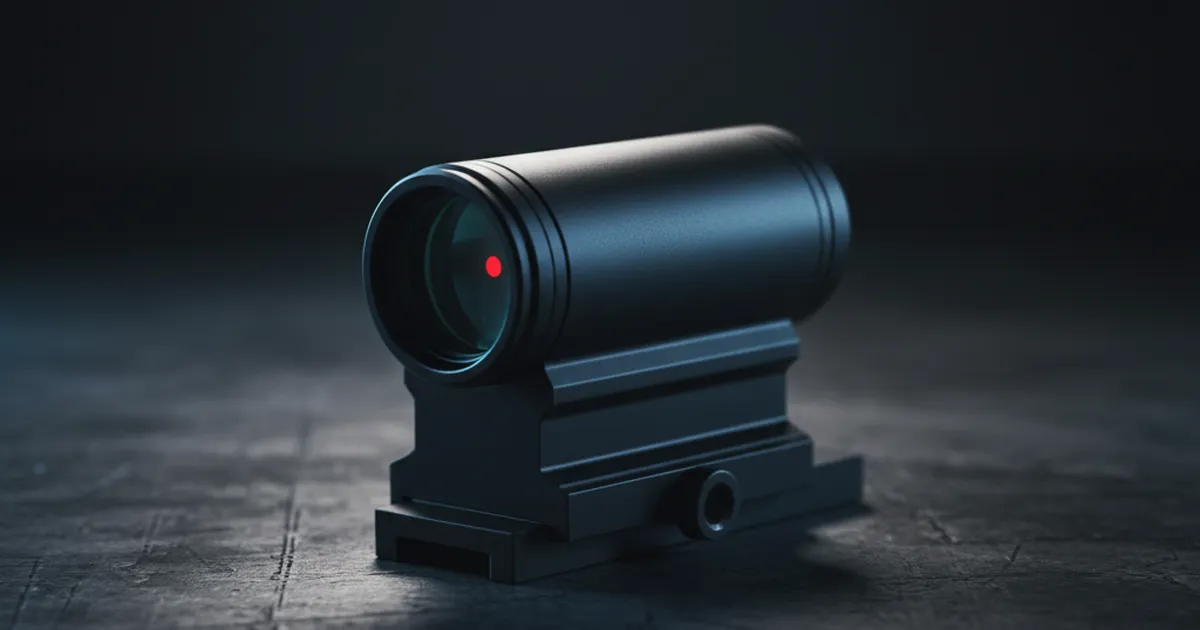
A solar red dot adds a photovoltaic panel to the housing. The key engineering detail: most solar models don't run directly off sunlight. They use capacitor-based power buffering with a solar failsafe, which keeps your reticle illuminated using ambient light if your battery dies unexpectedly during a stage or a shift.
The solar panel charges an onboard capacitor. That capacitor supplements or replaces battery draw in bright conditions. The primary cell stays in the circuit as a backup for low-light use — you still need it after dark.
So the real difference is redundancy. Battery-only optics like the Accufire QSO run a CR2032 with up to 20,000 hours of rated life. Solar-assisted models like the PCO-S ($239.99) add that capacitor layer on top, giving you a second power source when the sun cooperates.
Key Takeaways
- Power architecture: Battery-only dots rely solely on a CR2032 or CR1632 cell; solar models add a capacitor buffer charged by ambient light.
- Solar is supplemental: Most solar red dots still require a battery for low-light and nighttime use — solar extends life, it doesn't replace the cell entirely.
- Redundancy advantage: Capacitor-based solar failsafe keeps your dot alive if the primary battery drains mid-use.
- Price delta: Solar models typically run $10–$40 more than their battery-only counterparts at the same feature level.
- Use case matters: Outdoor daytime shooters benefit most from solar; low-light defensive setups lean on battery reliability above all else.
Understanding the physical differences is only half the battle; the real magic happens in how the optic decides which power source to use.
Power-switching logic, reverse-engineered
The solar cell does not recharge your battery. Full stop. What it actually does is feed current directly to the LED driver circuit, bypassing the battery entirely when ambient light crosses a usable threshold. The battery sits idle during that time — it is not being topped off, it is just not being touched.
Here is the sequence in plain terms:
- Photovoltaic input check: The optic's power management IC continuously samples the solar cell's output voltage. This happens passively, drawing negligible current.
- Threshold comparison: The IC compares solar output against the minimum voltage required to drive the LED at the selected brightness setting. Most designs set this threshold somewhere in the low-lumen range — bright enough for outdoor use, not enough for full indoor brightness.
- Capacitor buffering: A small capacitor smooths the solar cell's output before it reaches the LED driver. Without it, any shadow crossing the panel — your hand, a roofline, a cloud — would cause the dot to flicker. The capacitor holds enough charge to bridge those brief interruptions.
- Automatic source switching: If solar output drops below threshold, the IC switches load back to the battery. This transition is fast enough that you will not notice it during a stage.
- Battery-only fallback: In darkness or low-light environments, the optic runs entirely on battery. The solar cell contributes nothing below its minimum lumen threshold.
That last point matters more than most buyers realize. Low-light lumen thresholds prevent your dot from washing out or dying when transitioning from bright sunlight into a dark structure — but they also mean the solar cell goes offline the moment you step inside. Your battery takes the full load immediately.
Run a solar-equipped pistol optic through a course that mixes outdoor bays with a shoot house and the indoor stages run on battery power, every time. The solar cell earns its keep outside. Inside, it is dead weight until you step back into daylight.
The practical takeaway: solar extends battery life in sustained outdoor use, but the battery still needs to be functional and charged. A dead CR2032 means a dead dot regardless of how much sun is hitting the panel.
With extra circuitry comes extra mass, leading many shooters to wonder if that added bulk will compromise their pistol's reliability.
The solar panel weight penalty, measured
Short answer: no. The solar array on a pistol red dot adds so little mass that it will not alter your slide's cycling behavior in any measurable way.
Here is the reality. The solar array adds only a few grams over the equivalent battery-only optic — less than the weight of a single 9mm round. Your pistol's recoil spring is calibrated to handle the full loaded weight of the slide plus a mounted optic, and that handful of grams sits well within the margin it's designed for.
Solar-equipped optics on carry pistols run through carbine fundamentals drills without a single failure attributable to optic weight. The malfunctions that show up trace back to limp-wristing, weak ammunition, or a dirty chamber — not a few extra grams sitting on top of the slide.
Holster fit is a more legitimate concern than cycling reliability. A solar panel adds a small amount of height and surface area to the optic body. If your holster is cut tight to a specific optic profile, verify fitment before you carry. That said, the dimensional change is minor enough that most RMR-footprint holsters accommodate it without modification.
The upgrade from a battery-only model to a solar-equipped optic — say, from the $180 PCO Mini to the $240 PCO-S — lets you add solar redundancy without disrupting your pistol's recoil impulse, slide cycling, or holster fit. That is the practical takeaway.
Slide velocity is governed by spring weight, ammunition pressure, and slide mass — all of which dwarf the weight of a solar cell. If you are worried about five grams causing a malfunction, the more productive conversation is whether your recoil spring is worn out or your grip technique needs work. Those are the variables that actually matter on the range.
Once you realize the weight penalty is a non-issue, the decision comes down to comparing the raw specifications side-by-side.
Battery-Only vs. Solar-Backed Red Dots: The Hard Specs
The core mechanical difference is straightforward: a battery-only dot runs exclusively off a CR2032 cell, while a solar-backed model adds a photovoltaic panel that can supplement or replace that cell in sufficient light. Both still carry the same battery. Solar does not eliminate the CR2032 — it extends how long that cell lasts by offloading the draw when ambient light is available.
Both the QSO ($119.99) and the QSO-S Solar ($129.99) sit on the same footprint and run a 3 MOA dot. The $10 price delta buys you the solar panel and its associated circuitry. That's the entire hardware premium at this price tier.
| Spec | QSO (Battery-Only) | QSO-S (Solar-Backed) |
|---|---|---|
| Price | $119.99 | $129.99 |
| Power Source | CR2032 only | CR2032 + solar panel |
| Dot Size | 3 MOA | 3 MOA |
| Shake Awake | Yes | Yes |
| Footprint | Standard rifle mount | Standard rifle mount |
| Battery Check Required | Yes — periodic voltage check | Yes — CR2032 still present |
Both models use the same standardized mounting footprint. That matters practically: you are not buying a new adapter plate or milling anything to swap between them. The solar version drops onto the same rail as the battery-only version.
If you are deciding between footprints, check out our educational guide on footprint compatibility, or compare the Accufire PCO and QSO specs to see which fits your setup.
One spec that does not change between them: you still need to check battery voltage on the QSO-S. The solar panel reduces discharge rate, but a depleted CR2032 in low-light conditions leaves you with whatever the panel can produce. As noted by Battery University, cold temperatures further reduce cell voltage — which in a dark indoor range or overcast Wyoming morning means your dot is close to nothing. Check the battery on every optic before a range day regardless of power source. That habit does not change with solar.
Shake Awake is present on both units. After 4 minutes of no movement, the dot sleeps. Pick the gun up, the dot comes back. This feature does more for CR2032 longevity on the battery-only QSO than most shooters realize — and on the solar version, it stacks on top of the panel's contribution.
The weight delta between the two is negligible at this size class. If you are running a rifle carbine build and the solar panel's added mass concerns you, that concern belongs elsewhere in your kit.
While hardware specs dictate performance on paper, the software managing that hardware dictates whether your dot actually turns on when you need it.
Static timeouts matter more than panels do
Static timeout with motion-activated wake is the primary mechanism keeping your optic alive. Solar harvesting is the backup. Get that order wrong and you'll make the wrong buying decision.
Solar panels only produce meaningful charge under adequate ambient light. A holstered pistol, a rifle in a case, a gun stored in a drawer — none of those conditions produce usable solar input. The panel sits dark and contributes nothing. Meanwhile, if the dot stays on, the battery drains at full rate.
The 4-minute static timeout changes that math entirely. When the optic stops moving, it shuts off automatically. When you draw or pick it up, Shake Awake fires the dot back on before your muzzle reaches the target. That cycle — sleep, wake, sleep — is what stretches a CR2032 to 10,000+ hours of actual service life. Solar extends that number further under good conditions, but the timeout is what protects the battery when conditions are bad.
Consider the readiness scenario bluntly: the optic you grab at 0300 has been sitting motionless in the dark for hours. No solar input. No movement. The only thing standing between you and a dead dot is whether that sleep function actually fired and whether the battery had enough reserve left to wake up fast.
The same failure pattern shows up repeatedly: shooters leave their optic on between range sessions — sometimes for days. They assume the solar panel is "topping it off." It isn't, because the gun is in a bag or a safe. The battery drains to zero and they find out on the firing line.
Solar is a genuine advantage in the right conditions. But the timeout function works in every condition, every time, regardless of light. That's why it's the spec that actually determines battery survival.
Conclusion: Preparedness Over Gimmicks
Solar assist is a genuine feature, not a marketing trick — but it does not replace the discipline of keeping a fresh CR2032 in your optic. If you run a battery-only dot, change the battery on a schedule and carry a spare. If you run a solar-backed dot, do the same thing anyway.
The static timeout and Shake Awake logic covered earlier in this article will do more for your real-world readiness than the solar panel will. A dot that wakes up in under a second when you draw is worth more than one that harvests ambient light while sitting in a dark holster.
Dead optics from a skipped battery turn up far more often than solar panels ever save anyone. The fix is always the same: a two-dollar battery and a maintenance habit. Pick the optic that fits your mount, your use case, and your budget — then maintain it like your life depends on it, because in a defensive context, it might.
Edited April 22, 2026
Why Trust This Guide
Scope & Safe guides are written and reviewed by Marcus Reed and the Scope & Safe editorial team. Our recommendations are built on manufacturer specifications, published third-party data, and recognized testing standards — such as UL and ETL fire ratings — rather than manufacturer marketing, and every price and spec is verified against the seller's live product listing before we publish. We disclose our material connection to the brands we cover, including the Accufire and TactiBeaver stores — see our affiliate disclosure.
Recommended field reviews
The Best Optic I’m Running On My Pistol — Johnny Q
Product Review Off Grid CR123A Jessy Batteries — Solution Based Preparedness
Frequently Asked Questions About Solar vs Battery Red Dots
Will a solar red dot work reliably indoors or in low light?
Solar panels on red dots require ambient light to generate meaningful power — indoors under dim artificial lighting, the panel contributes almost nothing. Every solar-assisted optic I've tested still relies on battery backup in those conditions. The PCO-S keeps a CR1632 installed for exactly this reason. If your primary use case is indoor ranges or low-light defensive scenarios, treat the solar panel as a bonus, not a primary power source.
How long does a CR2032 battery last in a red dot sight?
Battery life varies by brightness setting and whether the optic has auto-sleep. The QSO runs up to 20,000 hours on a CR2032 with Shake Awake active — that's years of realistic use. Running max brightness continuously kills batteries far faster, sometimes in hundreds of hours. Auto-sleep with a 4-minute static timeout is the single biggest factor extending battery life, more than whether you have a solar panel at all.
Is a solar-assisted red dot worth the extra cost over a battery-only model?
For most shooters, probably not. The PCO-S runs $239.99 versus $209.99 for the battery-only PCO — a roughly $30 premium for solar backup. If you hunt or shoot outdoors year-round in bright conditions and genuinely forget to swap batteries, that redundancy has real value. If you're an indoor-range shooter or keep a maintenance schedule, you're paying for a feature you'll rarely use. Spend the difference on a spare battery carrier instead.
Can a solar red dot run with no battery installed at all?
Some high-end solar optics can sustain a dot in direct sunlight with no battery, but budget and mid-tier solar red dots generally cannot. The solar cell supplements the battery — it doesn't replace it. I wouldn't pull the battery out and trust the panel alone on anything I'm carrying for defensive use. Keep the battery installed, let the solar extend its life, and check the battery annually at minimum.
Does adding a solar panel make a red dot less durable?
The panel itself is a flat cell bonded to the housing — it doesn't meaningfully change structural integrity on well-built optics. The real durability question is whether the panel's integration creates new sealing failure points. On optics with proper IP ratings, this is a non-issue. The PCO-S adds only a few grams of total weight, which is negligible. What matters more is the housing material and recoil rating, not whether there's a solar cell on top.
Does Shake Awake technology save more battery than solar assist?
In most real-world use cases, yes. Shake Awake with a 4-minute static timeout keeps the optic off the majority of the time it's holstered or cased — that's where most battery drain happens. Solar only generates power when the optic is exposed to light, which is a fraction of total ownership time. Both features together are better than either alone, but if I had to pick one for battery longevity, auto-sleep wins the practical argument every time.