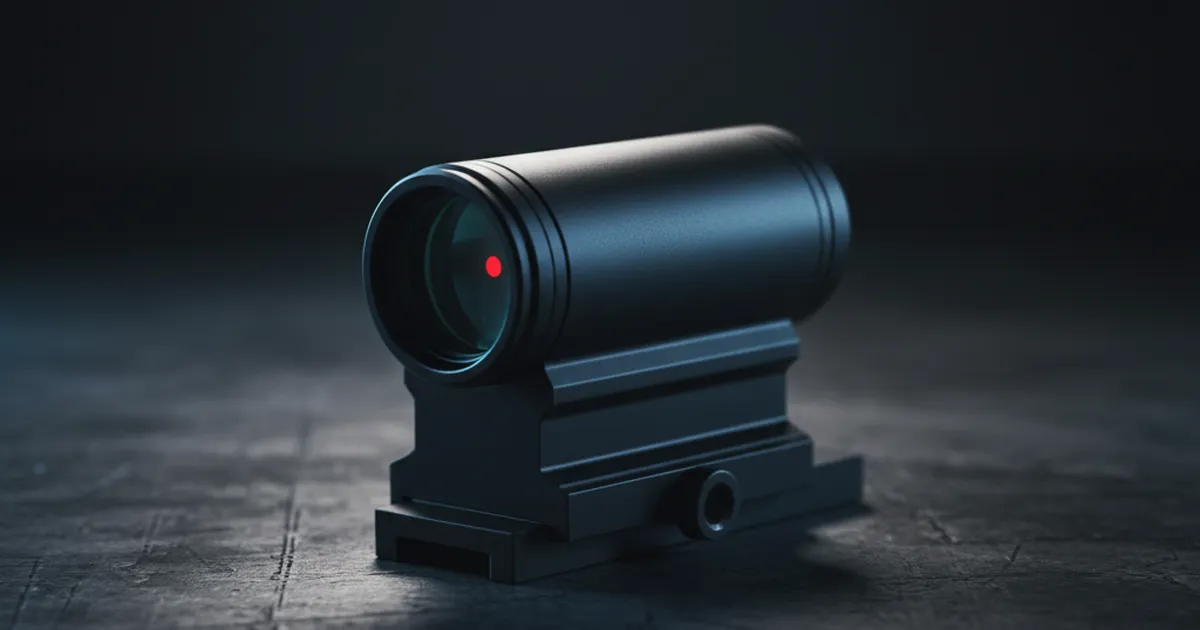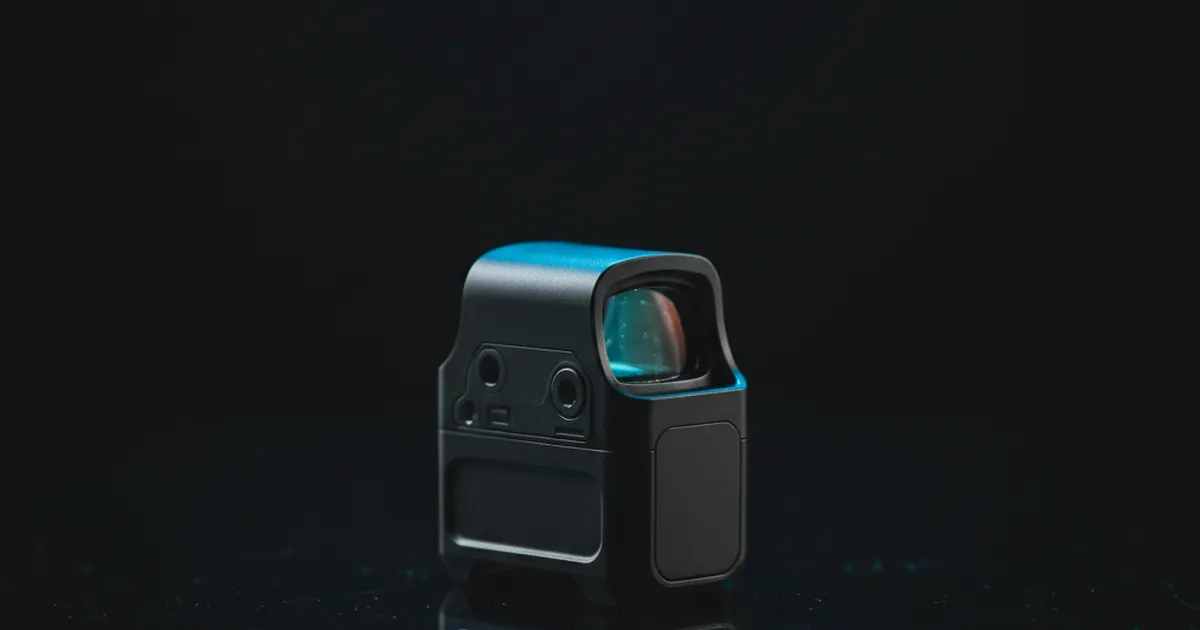

When comparing a red dot sight vs holographic sight, the core difference is light generation: a red dot sight uses an LED to reflect a simple aiming point off a coated lens, while a holographic sight uses a laser diode and mirrors to project a three-dimensional reticle hologram. This fundamental engineering difference dictates each optic's battery life, durability, and cost.
Video: Holographic vs red dot - Subtle details you missed
What is the Difference Between a Red Dot Sight vs Holographic Sight?
That engineering gap, LED reflection versus laser holography, determines how each optic handles real-world variables: shooter eye position, reticle clarity under stress, and power consumption over extended use. In a red dot sight vs holographic sight comparison, the LED-based design favors shooters who prioritize long battery life, lighter carry weight, and lower cost without sacrificing fast target acquisition. By design, LED-based optics hold a clear efficiency advantage over laser-driven alternatives.
A holographic sight suits shooters who need a more complex reticle pattern and a larger window for wide-angle situational awareness, particularly in close-quarters or high-stress environments where peripheral visibility matters. The trade-off is a heavier platform and significantly shorter battery life compared to LED-based alternatives.
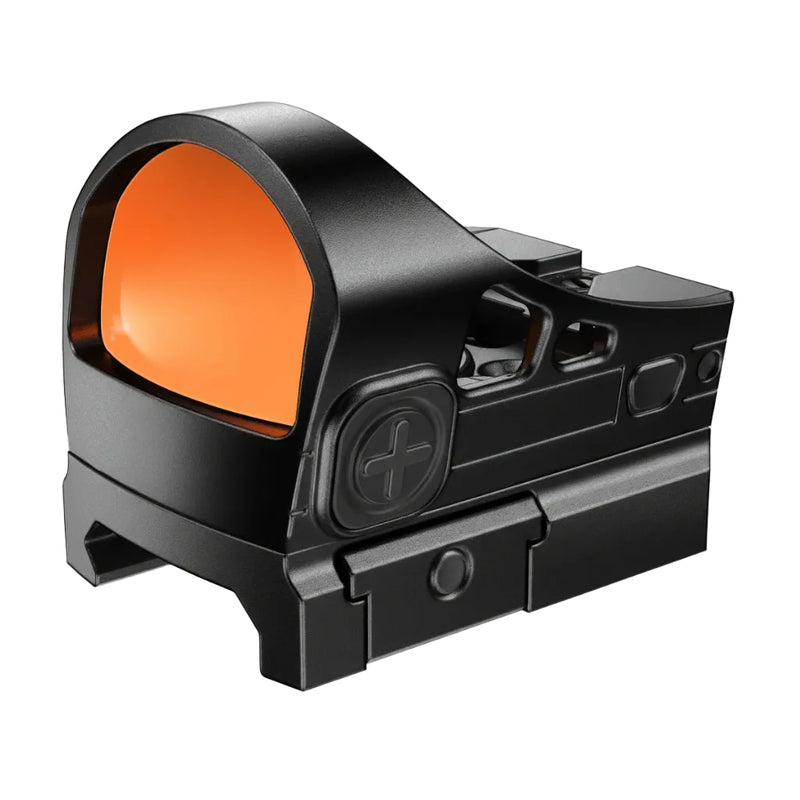
Red dot sights also offer greater eye-position forgiveness in a compact, lightweight package. The AZV QSO Red Dot Sight delivers a 3 MOA dot in a 7075 aluminum housing for $119.99, with battery life rated up to 20,000 hours, a practical advantage for extended field use.

Holographic sights maintain reticle size even if the window sustains partial damage, which can be a meaningful durability consideration in demanding conditions. However, their laser-driven systems consume power at a considerably higher rate, making battery management a real operational concern.
Technology at a glance:
| Feature | Red Dot Sight | Holographic Sight |
|---|---|---|
| Light source | LED | Laser diode |
| Reticle type | Simple dot, 2D | Complex pattern, 3D hologram |
| Battery efficiency | Very high | Moderate |
| Typical cost | Lower | Higher |
Every downstream performance difference, battery life, reticle clarity, window size, and platform weight, traces directly back to how each optic generates and displays its aiming point.
How Do Red Dot and Holographic Sights Work?
Red dot sights work by bouncing an LED beam off a specially coated lens, reflecting that dot back to your eye. Holographic sights use a laser diode and a series of mirrors to reconstruct a hologram of the reticle, one that appears to float at the target plane rather than sit on the glass.
That single engineering difference drives nearly every practical tradeoff between the two optic types.
The Red Dot Mechanism
An LED emits light toward a curved, partially reflective lens. The coating bounces the dot toward the shooter while allowing the downrange view to pass through. Because LEDs draw minimal current, battery life is exceptional. The AZV QSO Red Dot Sight achieves up to 20,000 hours on a single CR2032 cell.
The optic is also physically compact. The LED, lens, and housing require far less internal volume than a holographic system, which is why most red dots weigh and cost less.
The Holographic Mechanism
A laser diode fires through a series of beam splitters and mirrors, illuminating a holographic film embedded in the window. The interference pattern recorded on that film reconstructs the reticle image so it appears to exist downrange, not on the glass itself.
This process demands significantly more power than an LED. Holographic units typically run on CR123 batteries and still deliver a fraction of the battery life red dots offer at comparable brightness settings.
Why Astigmatism Changes Everything
Shooters with astigmatism often see a red dot as a starburst or smear because the LED's single point of light is distorted by an irregular cornea. A holographic reticle, being a reconstructed wavefront rather than a reflected point source, tends to appear sharper to the same eye.
Shooters with diagnosed astigmatism commonly report the holographic reticle looks crisper at identical brightness levels. For a deeper look at how optic choice interacts with eye physiology and zeroing, see our guide on how to sight in a red dot scope.
Quick Comparison
| Factor | Red Dot Sight | Holographic Sight |
|---|---|---|
| Light source | LED | Laser diode |
| Reticle location | On the lens | Appears downrange |
| Battery draw | Low | High |
| Astigmatism performance | Often distorted | Generally cleaner |
| Typical size | Compact | Larger housing |
Because holographic systems require complex laser arrays, they demand significantly more energy, bringing us to the most critical operational difference for modern shooters.
Why Does Battery Life Matter in Modern Optics?
Battery life directly determines whether your optic is a reliable tool or a liability. An optic that dies mid-session, or worse, during a home defense situation, is worse than no optic at all.
The Power Problem with Traditional Holographic Sights
Holographic sights use laser transmission systems that consume significantly more power than LED-based red dots. Many traditional holographic designs deliver roughly 1,000 hours of battery life at mid-brightness settings, less than six weeks of continuous use.
That gap matters. A shooter who leaves a holographic sight on overnight after a range session may return to a dead optic. If you train in multi-day courses without resupply, a holographic sight's power demands become a genuine logistical problem, not a theoretical one.
How Modern Red Dots Solve the Problem
LED technology draws a fraction of the power a laser system requires. The AZV QSO Red Dot Sight demonstrates what modern efficiency looks like in practice: up to 20,000 hours of battery life on a single CR2032, with a 4-minute auto-standby that cuts power when the optic sits still.
That 20,000-hour figure translates to roughly 833 days of continuous operation, a meaningful difference when comparing red dot sight vs holographic sight platforms.
Solar Assist and Shake Awake Technology
Solar-assisted power combined with Shake Awake technology means your optic is always ready when you need it, and conserving power when you don't. The solar panel supplements battery draw in ambient light, and Shake Awake detects motion and activates the dot in milliseconds.
If you carry daily and prefer not to manage weekly battery checks, this combination of features addresses the core reliability concern that separates red dot and holographic platforms in everyday use. Per published specifications, solar-assisted red dots extend operational intervals well beyond what any laser-based system can match on equivalent battery formats.
Constant-On vs. Smart Power Management
Running an optic in constant-on mode is standard practice for home defense, because you want zero activation delay. With a holographic sight, constant-on operation can drain a battery in days. A red dot with Shake Awake handles the same role without the weekly battery check.
| Optic Type | Typical Battery Life | Power Management |
|---|---|---|
| Holographic Sight | ~500–1,000 hours | Manual on/off only |
| LED Red Dot (standard) | ~5,000–10,000 hours | Auto-sleep on some models |
| LED Red Dot (solar + Shake Awake) | Up to 20,000 hours | Motion-activated + solar assist |
For range use, home defense, or daily carry, the math is straightforward. Fewer battery changes mean fewer opportunities for human error, and a sight that's ready when the situation demands it.
Explore solar-powered red dots to see how modern power management keeps your optic running for years.
Beyond power management, the physical construction of the optic housing plays a major role in whether it survives harsh field conditions.
Are Holographic Sights More Durable Than Red Dots?
Holographic sights once held a clear durability edge. They can still project a reticle even with a cracked front lens, which matters in a worst-case field scenario. That advantage is real, but it no longer tells the whole story.
Modern red dots have closed the gap significantly through material engineering. Housings built from 7075 aircraft-grade aluminum, the same alloy used in aerospace structural components, deliver drop resistance and structural rigidity that rival far heavier holographic designs.
The AZV QSO Red Dot Sight is a direct example: 7075 aluminum construction paired with an IPX-7 waterproof rating means it can be submerged in one meter of water for 30 minutes without failure. That spec matches or exceeds what many holographic sights offer at two to three times the price.
Some buyers find that the larger, more complex housing required by a holographic sight's laser transmission window introduces additional considerations: more surface area exposed to impact, more seals that could potentially fail, and more mass absorbing recoil over time. Without published independent drop-test comparisons, it is difficult to attribute any price gap solely to durability gains when evaluating red dot sight vs holographic sight options.
The honest answer in 2026: holographic sights retain one specific advantage, broken-lens functionality. Outside that edge case, a well-built red dot using aerospace-grade aluminum is equally field-ready, lighter, and considerably less expensive to replace if it does take terminal damage.
Durability keeps the optic running, but how it attaches to your firearm dictates its practical usability and overall system cost.
Which Mounting System Works Best: RMR or Proprietary Rails?
Red dot sights offer a broader mounting ecosystem for most standard builds. The standardized RMR footprint is machined directly into most factory pistol slides, letting you drop an optic on and go. No adapter plates, no riser blocks, no extra hardware budget.
Holographic sights follow a different path in the red dot sight vs holographic sight comparison. Their larger housings typically require a Picatinny rail adapter to mount on a handgun slide. That adapter adds height over bore, shifts your point of impact, and forces you to re-zero. For a step-by-step walkthrough of the zeroing process after any mount change, see our guide on how to zero a rifle scope.
The Real Cost of Adapter Plates
Quality Picatinny adapters for holographic sights run $40–$120 before you've even touched the optic. Stack that onto an already premium-priced holographic unit and the total system cost climbs fast.
A standard RMR footprint eliminates that expense entirely. The AZV PCO-S Reflex Red Dot Sight uses an RMR footprint for direct slide compatibility out of the box. At $239.99, that's the complete mounting solution included in the purchase price.
Height Over Bore: Why It Matters
Every millimeter of additional height changes your holdover at close range. Adapter-mounted holographic sights can sit 20–30mm higher than a direct-mounted red dot, creating a meaningful offset at defensive distances under 10 yards.
Direct RMR mounting keeps the optic as low as the slide geometry allows. Lower height over bore means your point of aim and point of impact stay tighter at close range, exactly where pistol optics earn their keep.
| Factor | RMR Footprint Red Dot | Holographic + Picatinny Adapter |
|---|---|---|
| Adapter cost | $0 | $40–$120 |
| Added height over bore | Minimal | Significant (20–30mm typical) |
| Installation complexity | Direct mount, simple | Multi-part assembly |
| Slide compatibility | Most factory-cut slides | Rail-equipped platforms only |
With mounting logistics and power management covered, a direct side-by-side comparison clarifies the final value proposition.
Red Dot vs Holographic Sight: Head-to-Head Comparison
Red dots win on battery life and price; holographic sights win on reticle complexity and window clarity. Neither dominates every category. The right choice depends on your specific use case and budget.
| Factor | Red Dot Sight | Holographic Sight |
|---|---|---|
| Battery Life | Up to 20,000 hours (CR2032) | 500–1,000 hours (AA/CR123) |
| Reticle Type | Single dot (2–6 MOA) | Complex holographic pattern |
| Window Size | Smaller (e.g., 28x17.5mm) | Larger, wider field of view |
| Mounting Footprint | Standardized (RMR, Picatinny) | Proprietary rails required |
| Housing Material | 7075 Aluminum | Aluminum alloy or polymer (varies by model) |
| Entry Price | From $119.99 | From $400+ |
| Parallax | Present at extreme angles | Reduced at standard distances; verify at extended ranges |
| Best Use Case | Pistols, rifles, extended field use | CQB, NV-compatible builds |
| Specifications vary by manufacturer and model. Verify against current product documentation. | ||
Battery life is where red dots pull decisively ahead. A quality red dot running up to 20,000 hours means years of use before a battery swap. Holographic units demand changes every few hundred hours under active use.
Price separation is equally stark. Red dot options start well under $200, while entry-level holographic sights rarely dip below $400. For most shooters, that gap is hard to justify without a specific operational need for holographic reticle technology. For a detailed breakdown of how red dot pricing compares across the market, see our red dot sight feature and price breakdown.
Looking at the raw data makes it easier to match the right technology to your specific firearm and mission requirements.
Which Optic Should You Choose for Your Build?
Choose a red dot sight for the vast majority of builds. Battery life up to 20,000 hours, lightweight 7075 aluminum construction, and RMR footprint compatibility with factory-cut slides make red dots the practical default for duty, competition, and everyday carry.
Holographic sights earn their place on one specific build: a passive night vision setup. Holographic sights hold an advantage here because their laser-based reticle can be tuned to NV-compatible brightness levels without the bloom that affects LED-based red dots at low settings. Outside that narrow use case, you're paying a significant price premium and accepting shorter battery life without a meaningful performance return.
For pistol builds, the RMR footprint is the deciding factor. The AZV PCO-S Reflex Red Dot Sight fits most factory-cut slides directly at $239.99, no adapter plates, no proprietary mounting headaches.
For rifle builds prioritizing always-on readiness, shake-awake technology and solar backup eliminate battery anxiety entirely. Holographic sights simply cannot match that operational reliability at equivalent price points. If you're evaluating a higher-magnification alternative for longer-range rifle work, the Accufire ATRO 20 rifle scope review covers a capable option at a competitive price.
The definitive answer: in the red dot sight vs holographic sight debate, red dots win on every practical metric except passive NV reticle compatibility. Build around a red dot unless your mission explicitly demands otherwise.
If you still have specific concerns about astigmatism or magnification, our frequently asked questions break down the finer details.
Final Thoughts on Optic Selection
The debate between a red dot sight vs holographic sight ultimately comes down to practical utility versus specialized performance. While holographic sights offer undeniable benefits for passive night vision use and shooters with severe astigmatism, the value equation has shifted heavily toward LED technology in 2026. Thanks to aerospace-grade 7075 aluminum housings, shake-awake power management, and standardized mounting footprints, modern red dots deliver exceptional reliability at a fraction of the cost and weight. For duty use, concealed carry, and general range applications, the extended battery life of a red dot simply cannot be ignored. If you are ready to upgrade your pistol or rifle setup with an optic that mounts directly and stays powered for years, explore RMR-compatible optics. Last reviewed April 16, 2026.
Why Trust This Guide
Scope & Safe guides are written and reviewed by Marcus Reed and the Scope & Safe editorial team. Our recommendations are built on manufacturer specifications, published third-party data, and recognized testing standards — such as UL and ETL fire ratings — rather than manufacturer marketing, and every price and spec is verified against the seller's live product listing before we publish. We disclose our material connection to the brands we cover, including the Accufire and TactiBeaver stores — see our affiliate disclosure.
Frequently Asked Questions About Red Dots and Holographic Sights
Here are the most common questions shooters ask when deciding between a red dot sight and a holographic sight, covering astigmatism, battery life, and magnification compatibility.
Do holographic sights perform better than red dots for shooters with astigmatism?
Holographic sights generally produce a cleaner dot for shooters with astigmatism because the reticle is projected at the target plane rather than reflected off a lens. Red dot sights reflect an LED off a curved lens, a process that can cause the dot to appear starburst-shaped or smeared when astigmatism is present. Shooters with moderate astigmatism often report the holographic reticle looks sharper, though results vary by individual prescription severity.
Which sight type has longer battery life — red dot or holographic?
Red dot sights win decisively on battery life. Quality red dots like the AZV QSO Red Dot Sight deliver up to 20,000 hours on a single CR2032 battery. Holographic sights typically run 500–1,000 hours under comparable conditions because their laser-based projection systems draw significantly more power. For duty use or extended field operations where battery swaps are inconvenient, red dots hold a clear practical advantage.
Can you use a magnifier behind both red dot and holographic sights?
Yes, both sight types are compatible with flip-to-side magnifiers. Holographic sights have a slight edge here. Their reticle maintains its apparent size and clarity when magnified because the pattern is etched into the optical element. Red dot reticles can appear slightly degraded or enlarged under magnification. That said, most shooters using 3x magnifiers behind quality red dots report fully acceptable performance for carbine-distance engagements.
Are holographic sights worth the higher price over red dot sights?
For most civilian shooters and competitive athletes, no. The price premium is hard to justify. Holographic sights often cost two to four times more than comparable red dots while offering marginal real-world performance differences at typical engagement distances. Red dots deliver faster target acquisition, longer battery life, and proven durability at a fraction of the cost. The holographic advantage becomes meaningful mainly for shooters with astigmatism or those running magnifiers regularly in professional roles.
Does window size affect performance differently between red dot and holographic sights?
Window size affects both types equally. A larger window improves situational awareness and makes it easier to acquire the reticle under stress. The AZV PCO-S Reflex Red Dot Sight features a 28x17.5mm window, which provides a wide field of view for fast target transitions. Holographic sights typically offer larger windows by design, but modern open-reflex red dots have closed that gap considerably in 2026.
Which sight is better for pistol use — red dot or holographic?
Red dot sights are the clear choice for pistols. Their compact footprint, lighter weight, and RMR-compatible mounting make them purpose-built for handgun slides. Holographic sights are too large and heavy for practical pistol carry. Features like shake-awake technology, which activates the optic the moment the pistol moves, make modern red dots highly reliable for defensive use. Battery life advantages also matter more on a carry gun where regular maintenance checks may be infrequent.
Sources
- American Academy of Ophthalmology. "What Is Astigmatism?" aao.org. Accessed 2026.
- International Electrotechnical Commission. IEC 60529: Degrees of Protection Provided by Enclosures (IP Code). iec.ch. Accessed 2026.
- ASM International. "7075-T6 Aluminum Alloy Material Properties." asminternational.org. Accessed 2026.