
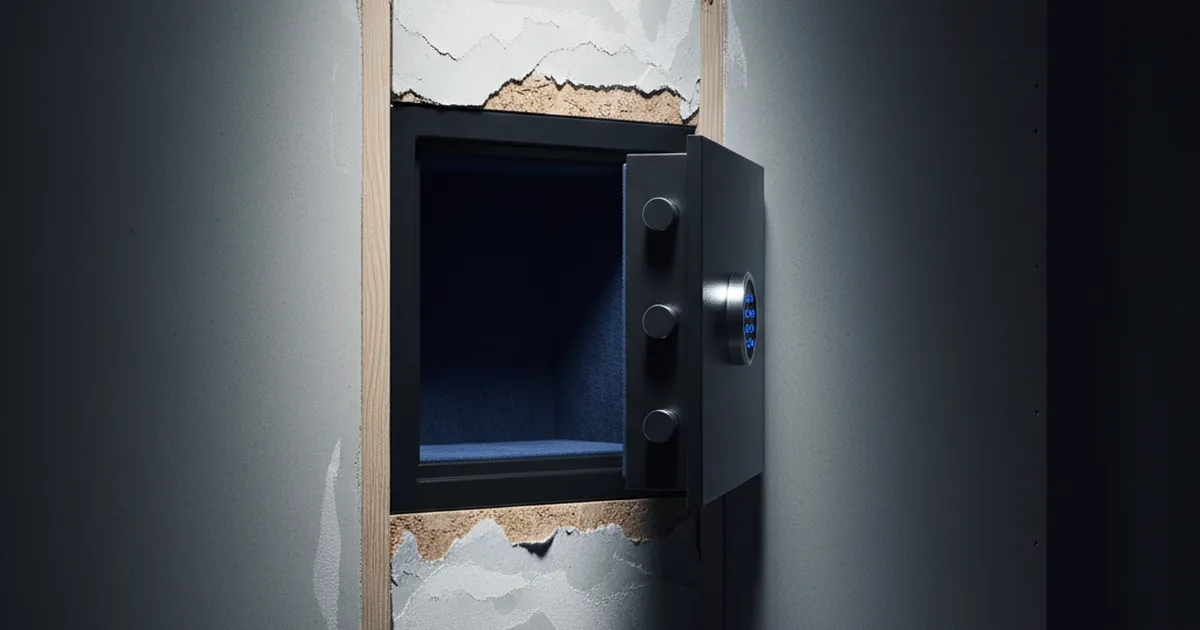

An in-wall gun safe solves a problem the big floor safe can't: it puts a firearm within reach in the room you actually need it, without a 400-pound steel box announcing itself in the corner. An in-wall gun safe is a slim security container recessed into the empty cavity between a wall's framing studs, hidden behind a mirror, picture, or panel, and sized to hold handguns, documents, or — in full-length models — a long gun. The catch is that a stud bay is shallow, so you trade some steel and capacity for concealment and access.
Key Takeaways
- Depth is the constraint. A standard 2x4 wall gives about 4 inches of depth and ~14.5 inches of clear width between 16-inch on-center studs. Measure before you buy.
- Most in-wall safes are not fireproof. A 4-inch cavity is too shallow for real fire insulation — if fire protection matters, that's a job for a deeper standalone safe.
- Full-length vs half-height decides whether you can store a rifle. 44–53-inch models take a long gun with shelves removed; 31-inch models are pistols and valuables only.
- Lock type is the speed-vs-reliability call: biometric is fastest in the dark, keypad is reliable, mechanical SimpleX never needs a battery.
- Conceal it. The whole point is that a thief never sees it — behind a hinged mirror or a picture frame is the classic install.
What to Look for in an In-Wall Gun Safe
Because the wall cavity dictates the form factor, the buying decision comes down to four things, in roughly this order:
- Fit. Confirm your stud spacing (standard is 16 inches on center) and wall depth (4 inches for a 2x4 wall, 6 inches for 2x6). A safe that needs 5.75 inches won't sit flush in a 2x4 wall.
- Capacity. Decide handgun-and-valuables vs long-gun. That single choice eliminates half the market — half-height safes simply can't take a rifle.
- Access method. Biometric for the fastest stress access, keypad for proven reliability, mechanical for zero battery dependence. All the good ones include a backup.
- Build. Steel gauge (lower is thicker), deadbolt count, and an anti-pry door. Concealment is your first layer of security, but the box still has to resist a quick attack if it's found.
| Safe | Size | Lock | Long gun? | Price |
|---|---|---|---|---|
| SnapSafe Tall (75414) | 44 in | Keypad + key | Yes (shelves out) | ~$449.99 |
| TactiBeaver SLATE | Full-length | Biometric | Yes | $169.99 |
| Langger Large | 45 in | Biometric + PIN | Yes (shelves out) | ~$279.99 |
| Barska AX12408 | 31.5 in | Biometric | No | ~$471.99 |
| V-Line Closet Vault II | 53 in | Mechanical SimpleX | Yes | ~$749 |
1. SnapSafe Tall In-Wall (75414) — Best Build
The SnapSafe Tall In-Wall (~$449.99) is the one to beat on construction: a 16-gauge body with an 8-gauge door — the thickest door in this group — from a brand with a real reputation. At 44 inches it's a true full-length safe that takes a rifle with the shelves removed, and the spring-assist door makes it pleasant to use. The honest trade-off is access: it's keypad-only, which is a beat slower than biometric in a 2 a.m. scenario, and at 66 pounds it's a heavier install whose door frame protrudes from the wall. If build quality and rifle capacity top your list over fingerprint speed, this is the pick.
2. TactiBeaver SLATE Biometric — Best Value
The TactiBeaver SLATE ($169.99) makes the rest of the biometric field look overpriced. It mounts flush between standard 16-inch studs, hides behind a mirror or picture, and opens on a 0.2-second fingerprint scan — and it does that for well under half the price of the comparable biometric wall safes here (the Langger is $280, the Barska $472). For the buyer who specifically wants biometric access in a concealed between-studs safe, the value gap is hard to argue with. You give up the SnapSafe's 8-gauge door, so if a pry attack on a discovered safe is your top worry, step up — but for fast, hidden, affordable access it's the standout.
3. Langger Large Biometric — Closest Spec Twin
The Langger Large Biometric (~$279.99) is the nearest thing to the SLATE: a 45-inch full-length between-studs safe with a fast 0.1-second scanner, 20 fingerprint slots, PIN and key backups, two motorized deadbolts, and three removable shelves for a long gun. It's a capable safe — but it costs $110 more than the SLATE for a similar job, comes from a generic import brand with a thinner support and warranty track record, and doesn't publish a steel gauge. A solid alternative if the SLATE is unavailable; otherwise the price difference is hard to justify.
4. Barska AX12408 — Best Half-Height Biometric
The Barska AX12408 (~$471.99) is genuinely engineered for 16-inch studs and a 4-inch wall, with a big 120-fingerprint database, an interior LED, a fold-down tray, and a hidden inner compartment. It's well made and a fine pick for handguns, jewelry, and documents. The limitation is simple: at 31.5 inches it's a half-height safe, so it cannot take a rifle — and it still costs more than the larger-capacity SLATE. Buy it if your need is concealed valuables-and-pistol storage, not long guns.
5. V-Line Closet Vault II — Best Battery-Free
For the buyer who refuses to depend on electronics, the V-Line Closet Vault II (~$749) is a made-in-USA 14-gauge vault with a mechanical SimpleX push-button lock that never needs a battery, a three-point deadbolt, and CA DOJ approval. It's the most reliable lock in the group — there's nothing to drain or glitch. The costs are real: it's the priciest option here, mechanical entry is slower than a fingerprint, and at nearly 6 inches deep it needs a 2x6 wall or a furred-out 2x4.
The Picks: Match the Wall to the Job
If you want the toughest steel and a rifle's worth of room, the SnapSafe 75414 earns it on build alone. If you want biometric speed and concealment without overpaying, the TactiBeaver SLATE ($169.99) is the value play and the easiest fit between standard studs. The Langger is the backup biometric, the Barska is the half-height valuables pick, and the V-Line is for anyone who wants a lock that can't die. Budget shoppers will also see the keyed Stack-On IWC-55 (~$80–$100) and the mirror-faced Tactical Walls 1450 ($799) — the former is a thin-steel cabinet, not a true safe; the latter is the best pure concealment if security is secondary to looking like a mirror. Whatever you choose, the cavity dimensions decide it, so measure first.
Frequently Asked Questions
How deep does an in-wall gun safe need to be, and will it fit my wall?
A standard interior 2x4 wall gives you about 4 inches of usable depth and roughly 14.5 inches of clear width between studs spaced 16 inches on center; a 2x6 wall gives about 6 inches of depth. Match the safe's exterior depth to your wall — a unit that needs 5.75 inches won't sit flush in a 2x4 wall without furring it out. Always measure your actual stud spacing and depth before ordering, since older homes vary.
Are in-wall gun safes fireproof?
Generally no. A 4-to-6-inch stud cavity is too shallow to pack the fireboard insulation a real fire rating requires, so most in-wall safes are security containers, not fire safes. If protecting documents or firearms from a house fire is a priority, that job belongs to a deeper standalone fireproof safe — use the in-wall unit for fast, concealed access and keep irreplaceable items in a fire-rated box.
Do in-wall safes fit between standard 16-inch studs, and do I have to cut a stud?
The common in-wall safes are sized for 16-inch on-center framing and drop into the bay without cutting a stud — you remove the drywall, frame a little blocking above and below for support, and anchor the safe to the studs. If your home uses 24-inch spacing or you want a wider safe, you may need to sister in framing. Cutting a load-bearing stud is a job for a contractor.
Biometric, keypad, or mechanical — which lock is best for an in-wall safe?
Biometric is the fastest under stress and works in the dark without a code, which is why it suits a concealed defensive safe. Keypad locks are reliable and well proven. Mechanical SimpleX locks never need a battery, which is the strongest argument for them. The best answer is whichever you'll trust at 2 a.m. — and confirming the backup entry (key or override) works one-handed before you rely on it.
Can an in-wall safe hold a rifle, or just handguns?
Full-length models, roughly 44 to 55 inches tall, hold one or two long guns once you remove the interior shelves, plus handguns and valuables on the shelves when installed. Half-height safes around 31 inches are pistols-and-valuables only. If long-gun storage is the goal, filter to the tall full-length units like the SnapSafe, SLATE, Langger, or V-Line — and confirm the interior height clears your specific rifle.
Why Trust This Guide
Scope & Safe guides are written and reviewed by Marcus Reed and the Scope & Safe editorial team. Our recommendations are built on manufacturer specifications, published third-party data, and recognized testing standards — such as UL and ETL fire ratings — rather than manufacturer marketing, and every price and spec is verified against the seller's live product listing before we publish. We disclose our material connection to the brands we cover, including the Accufire and TactiBeaver stores — see our affiliate disclosure.